
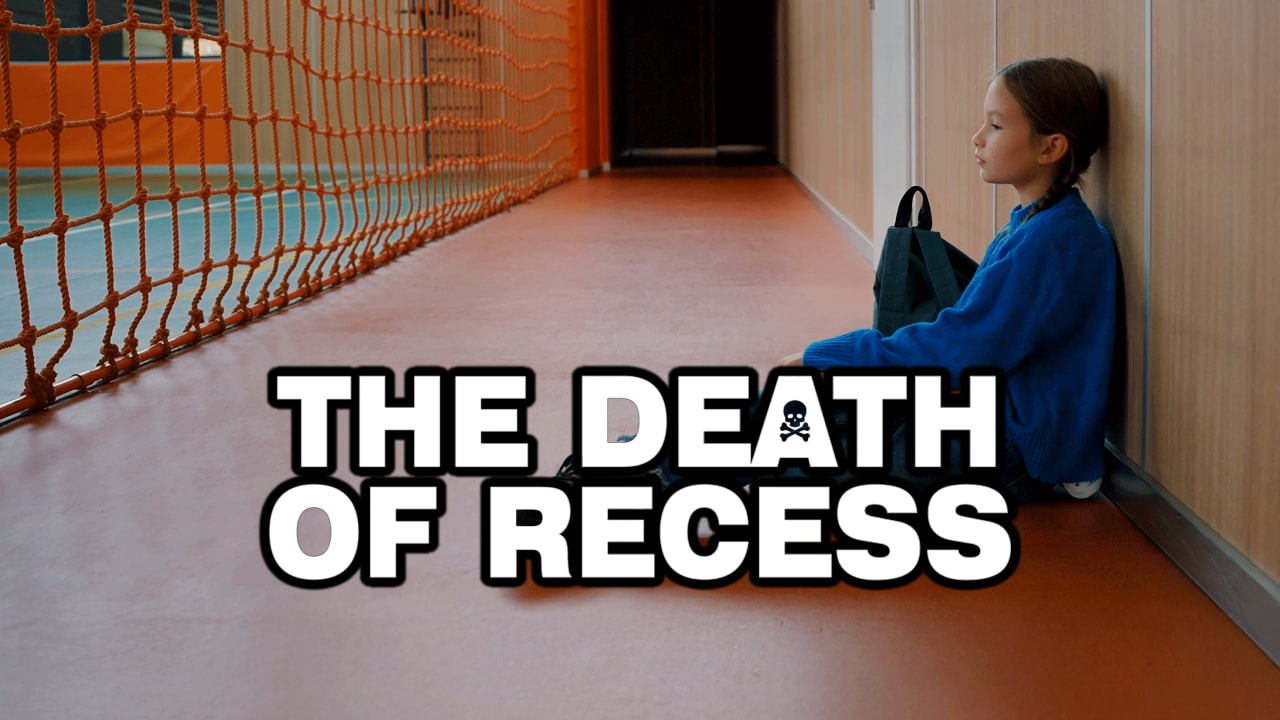
Death of Recess
SHOW TYPE

MOVIE
SHOW LENGTH

PROTECTION

TV-14
RELEASED

2025



The Death of Recess is a powerful, eye-opening documentary that challenges the foundations of modern education.
Through firsthand investigations, expert interviews, and personal storytelling, filmmaker Spencer Taylor exposes how standardized testing, bureaucracy, and ideology have reshaped childhood—while uncovering bold alternatives restoring curiosity, creativity, and hope for the next generation.

Community verdict · separate from the catalog
No community verdict yet · In the catalog
Reviewed and in the catalog. Community verdict: not woke — 100% of 1 members did not file a woke label.
1 of 1 did not label it woke · 5 members to decide
Community rank · quality, not a gate
Low scores stay in the catalog.
Report a mistake
Same rule as woke labels: one report, a written reason, and the community +1 or −1 it — once per member. A net +5 applies the change. Editors can also apply it immediately.
No mistake reports yet.
Sign in to report a mistake. One report per field, per member.
Woke labels
Members can file a published criterion and itemized evidence. Other members +1 or −1 that reason — once. If 10% of members who weighed in file a label, and a reason reaches net +5, that rank keeps the title omitted from the database. Weak labels do not.
No labels filed yet.
Comments and reviews
Peg Harlan
+7 cloutSep 30, 2026
I sat down with the remote last Tuesday after supper and put on Death of Recess because the title caught my eye. My husband was grading papers at the kitchen table—he still substitutes now and then—so I figured we could talk about it after. Spencer Taylor made this documentary, and he goes into schools and talks to teachers and parents and kids about what happened to plain old playtime. It starts with some grainy footage of kids running around blacktop in the 80s and 90s, then cuts to today's classrooms where the clock is watched like a hawk and recess got shaved down to nothing so they could squeeze in more test prep. I recognized that feeling right away. My own kids came home tired and jumpy for years, and I always blamed the long bus ride. Turns out the schedule itself was the culprit. Taylor keeps the camera steady and lets people talk. He interviews a principal in Ohio who shows the old daily schedule taped next to the new one. Recess went from forty minutes to twelve. An elementary teacher in Texas describes packing extra worksheets into what used to be free time because the state report card hangs over her head. None of these folks sound bitter for the sake of it. They just sound worn out. You can see it in their faces—the same look my sister gets after parent-teacher conferences. The film does not dress them up with dramatic music or flashing graphics. The lighting in some of the school hallways is flat and a little green, the way fluorescent bulbs always are, and a couple of the interview rooms look like they were borrowed from a church basement. I didn't mind. It felt honest instead of polished for a festival. What stuck with me was the section on bureaucracy. Taylor sits with a superintendent who walks through the forms required just to take kids outside for twenty minutes. Liability waivers, certified monitors, curriculum alignment checklists. By the time the paperwork is done the sun has moved and the kids have already lost the window. My husband snorted when that part came on. He said it matched every memo he ever got from the district office. The movie also digs into how testing seasons wipe out whole weeks of normal school. Kids practice bubble sheets instead of building forts out of cardboard or arguing over rules for tag. One dad in Michigan films his son's after-school meltdown and just lets the camera roll. No narration over it. You sit there and feel the weight. They show some places that pushed back. A charter school in Indiana put recess back to thirty-five minutes and dropped the daily quizzes. Teachers there talk about kids coming back to class calmer and actually finishing their work faster. A private academy in rural Pennsylvania lets the older students design their own outdoor games and keeps the younger ones on real dirt and grass instead of foam mats. These segments are hopeful without turning syrupy. Nobody claims recess alone fixes every problem. They just show what happens when adults stop treating childhood like a manufacturing line. I appreciated that restraint. Too many documentaries these days want you to sign a petition before the credits roll. This one mostly trusts you to notice the difference. There is a stretch near the middle that leans on charts about attention spans and doctor interviews about rising anxiety. Some of the graphs stay on screen a beat too long and the doctor's office set looks borrowed, with a plastic plant in the corner that has seen better days. Still, the information lands because it comes after the real faces. A grandmother who volunteers at her grandson's school talks about how the kids used to settle arguments themselves on the playground and now wait for an adult with a clipboard. That line stayed with me. I thought of my own grandkids and how little unstructured time they get. Taylor himself appears sparingly. He narrates in a calm Midwestern voice—nothing flashy—and when he does step in front of the camera he looks like any dad at a school board meeting. He does not pretend to have all the answers. He just keeps pointing at the schedule and asking why we accepted the trade. By the end I felt more clear-headed than angry. The film runs a little under two hours, and it never felt padded. I could have done with one fewer expert in a suit, but the classroom and playground scenes carry the load. Would I watch it again with my husband? Yes. We talked about it while he stacked the graded quizzes. He said it put words to something teachers have grumbled about for twenty years. The production is simple, the interviews feel real, and the alternatives shown are practical rather than pie-in-the-sky. If you have kids or grandkids in school, or if you simply remember what it felt like to run until the bell rang, this one is worth an evening. It does not shout. It just shows the clock and asks whether we are measuring the right things. I went to bed thinking about the little girl in the Ohio segment who still draws hopscotch grids on her driveway because the schoolyard is locked after dismissal. That image is going to stay with me longer than any graph.