
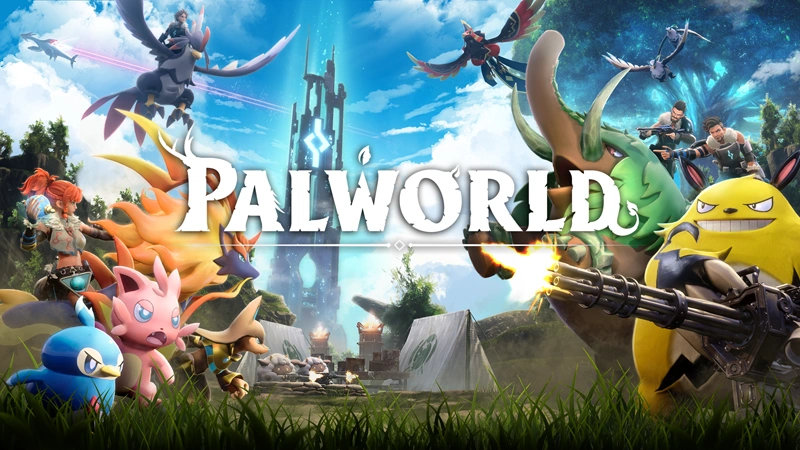
Palworld
SHOW TYPE

GAME
DEVELOPER

Pocketpair
PROTECTION

T (Teen)
RELEASED

2026



Palworld is a monster-taming game created and published by Japanese developer Pocketpair.
It was announced in 2021 and launched through early access for Windows, Xbox One, and Xbox Series X/S in January 2024, and for the PlayStation 5 in September 2024.
The game was fully released on July 10, 2026.

Community verdict · separate from the catalog
No community verdict yet · In the review queue
2 of 5 members have weighed in. 100% have not labeled it woke. Search already lists this title; a community verdict lands at five.
2 of 2 did not label it woke · 5 members to decide
Community rank · quality, not a gate
Rank it — a rank is a vote that it is not woke. The catalog waits on a verdict and a written review.
Report a mistake
Same rule as woke labels: one report, a written reason, and the community +1 or −1 it — once per member. A net +5 applies the change. Editors can also apply it immediately.
No mistake reports yet.
Sign in to report a mistake. One report per field, per member.
Woke labels
Members can file a published criterion and itemized evidence. Other members +1 or −1 that reason — once. If 10% of members who weighed in file a label, and a reason reaches net +5, that rank keeps the title omitted from the database. Weak labels do not.
No labels filed yet.
A review is on the record even before the verdict. The title still needs 90% of members not labeling it woke before a review can put it in the catalog.
Comments and reviews
Omar Quill
+8 cloutSep 11, 2026
I sat down with Palworld over several evenings after it left early access and reached its full release in the middle of 2026. I am not someone who plays every new survival title that appears, so I came to this one mostly out of curiosity about the premise. You wake up in a large open world filled with strange creatures called Pals. The first hours involve punching trees and rocks like every other crafting game I have ever tried, gathering wood and stone, and slowly putting together a simple base. Soon enough you craft spheres that function like capture devices, and you start throwing them at the creatures roaming the grasslands and forests. Once a Pal is caught it becomes part of your team. You can bring a few of them out into the field to fight beside you, or you can assign them to work stations back at camp so they mine ore, chop lumber, tend crops, or cook food while you are away exploring. The loop is straightforward and strangely absorbing. You explore a region, battle wild Pals, capture the ones you want, level them up, and return to expand your base. The world itself is quite large. There are different biomes with their own weather and resources, towers to climb, and tough boss Pals that require careful preparation. Combat mixes the creature-battling style many people know from older monster games with direct gunplay. You carry firearms and can shoot enemies yourself while your Pals use their elemental abilities. I found myself switching between those two approaches constantly. Some fights feel better when you hang back and let a strong fire-type Pal handle the heavy work. Other times you empty a magazine into a charging boss and then dodge out of the way. The combination is odd on paper and still a little uneven in practice, yet it keeps the action from becoming repetitive. What surprised me most was how much time I spent on the management side. Building a working base requires planning power generators, conveyor lines, breeding pens, and defense towers. The Pals have work preferences and skills. Assign the wrong one to a task and production slows down. Assign the right combination and you suddenly have a small automated settlement humming along. Multiplayer co-op is available, and I tried a few sessions with two friends. Coordinating who handles exploration and who stays behind to keep the base running made the grind feel lighter. Boss raids together were the highlight. The larger enemy Pals hit hard, and having three people with different teams made those encounters feel properly dangerous rather than simply long. The tone of the game is darker and more irreverent than the cute creature designs first suggest. You can capture human poachers and bandits with the same spheres you use on Pals, then put those humans to work or sell them. The game does not hide this. It leans into the joke and treats the whole arrangement as part of the survival economy. I am still not certain how I feel about that decision as a design choice, but it is consistent and never pretends to be wholesome. The Pals themselves remain charming in appearance even while they are being ordered around a mining camp or sent into a firefight. That contrast is the entire joke of the product, and the developers never apologize for it. Performance on my machine was acceptable after the final release patches. The world loads in large chunks, and there are moments when dozens of Pals and structures are active at once that can cause frame dips, especially if you have overbuilt your base. The interface for assigning work is functional but a little cluttered, and inventory management grows tiresome once you start carrying resources, spheres, weapons, and Pal gear all at the same time. None of these issues ruined the experience for me, though I can see how someone who dislikes inventory juggling would grow frustrated. The progression curve is long. Reaching the higher-tier Pals and the later map regions takes dozens of hours. I put in a little over sixty hours and still had regions I had only briefly scouted. The game respects that investment by giving you adjustable world settings so you can dial difficulty, resource rates, and death penalties to suit your patience. I should mention the creature designs more carefully because they are a large part of why the game works. Many Pals look like playful mash-ups of familiar animal shapes with small mechanical or elemental twists. A few of them became favorites simply because their idle animations and work animations were funny to watch around the base. The breeding system lets you mix traits, which adds another layer of planning for players who enjoy optimizing teams. I never went deep into the absolute min-max side of breeding, yet even casual experiments produced useful workers and fighters. Overall the craft is solid enough for what it sets out to do. It is not a polished narrative experience with deep characters or a carefully written story. There is almost no story beyond the premise of stranded survivors and mysterious islands full of Pals. What it offers instead is a large playground that combines building, fighting, capturing, and light automation, and it does so without lecturing the player about any of it. The humor is mean-spirited in places and the loop is deliberately grindy. Both of those traits will put some people off. For players who like open-world survival games and who also enjoy collecting and raising combat creatures, the mix lands cleanly. I finished my main playthrough satisfied that I had seen most of what the full release had to offer, and I still catch myself thinking about which Pal I would put on cooking duty if I started another world. The whole thing is a ridiculous toy box that somehow keeps working for far longer than it has any right to.