
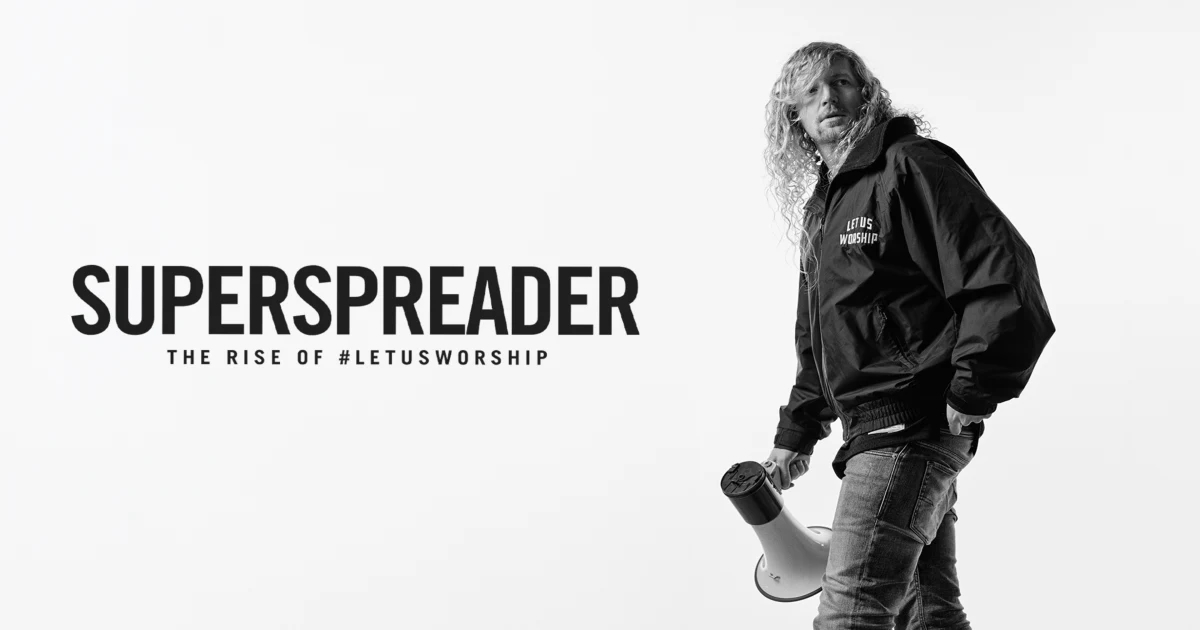
Superspreader
SHOW TYPE

MOVIE
SHOW LENGTH

1 hr, 15 min
PROTECTION

PG-13
RELEASED

2022



Future generations will look back at the COVID-19 pandemic with far greater clarity and sensibility than any of us can today.
Superspreader is a captivating, soul-moving experience and also promises to be an integral exhibit for generations to come as they piece together the out-and-out madness that was the pandemic.

Community verdict · separate from the catalog
No community verdict yet · In the catalog
Reviewed and in the catalog. Community verdict: not woke — 100% of 2 members did not file a woke label.
2 of 2 did not label it woke · 5 members to decide
Community rank · quality, not a gate
Low scores stay in the catalog.
Report a mistake
Same rule as woke labels: one report, a written reason, and the community +1 or −1 it — once per member. A net +5 applies the change. Editors can also apply it immediately.
No mistake reports yet.
Sign in to report a mistake. One report per field, per member.
Woke labels
Members can file a published criterion and itemized evidence. Other members +1 or −1 that reason — once. If 10% of members who weighed in file a label, and a reason reaches net +5, that rank keeps the title omitted from the database. Weak labels do not.
No labels filed yet.
Comments and reviews
Omar Quill
+8 cloutSep 5, 2026
I sat down with Superspreader on a quiet evening because the description promised a clear-eyed look at the years most of us would rather not relive in detail. The film opens with a slow montage of empty freeways, taped-off playgrounds, and television anchors speaking over graphics of rising case numbers. A narrator with a calm, measured voice tells us that future generations will understand the period better than we can, and then the picture settles into a series of personal accounts stitched together with news clips and a few on-camera experts. The first hour follows three main threads. There is a young nurse in a Midwestern hospital who walks us through her shifts, the PPE shortages, and the strange quiet of the parking garage when she finally leaves at dawn. There is a restaurant owner whose business collapses after the indoor dining ban, and we watch him cart out chairs and argue with a landlord on the phone. And there is a multigenerational household where the grandparents insist on remaining cautious while the adult children grow restless about missed birthdays and lost wages. The camera stays close, sometimes uncomfortably so, and the editing lets long pauses hang so that the weight of each complaint can land. I found myself nodding at ordinary details: the smell of hand sanitizer that never quite left the car, the way people stepped off sidewalks to keep distance, the sudden importance of a thermometer. Around the midpoint the film shifts focus to what it calls superspreading events. We see footage of a choir practice, a wedding reception that went ahead anyway, and a packed funeral. Interviews with people who attended those gatherings are intercut with contact-tracing diagrams and hospital capacity charts. One man who became infected after a birthday party speaks without much polish about how quickly his mild symptoms turned serious. A public-health official explains aerosol transmission with a plastic model of a room. The movie is careful to show both the human cost and the mathematical side, though it never quite decides which is more important. Music swells under the heavier moments. I noticed the score relies on slow piano and low strings, the sort of thing that signals gravity without earning it every time. In the final third the tone becomes more reflective. On-screen text appears over still photographs of masked faces and deserted stadiums, asking what the record will look like decades from now. Several of the earlier subjects are brought back for brief updates: the nurse has left bedside work, the restaurant space is now a storage facility, the family has reunited but still argues about what should have been done differently. There is a short sequence of street interviews in which strangers offer one-sentence opinions on mandates, school closures, and personal responsibility. The film does not press them hard. It simply lets the range of answers sit there and then moves on. I appreciated that it avoided shouting matches, yet I also felt the absence of sharper questioning. The piece seems content to collect fragments and arrange them neatly rather than press any single claim to its limit. Technically the production is competent. The interviews are lit evenly, the archival material is clear, and the pacing rarely drags into pure monotony, though it does circle the same emotional beats more than once. A few sequences feel padded with slow-motion footage of rain on empty streets that could have been cut without loss. The total running time is long enough that I checked the clock twice near the end. What stays with me is less any single revelation than the cumulative texture of ordinary disruption. People lost routines, savings, and a certain casual trust in public space. The movie records that texture honestly enough. Still, honesty of surface detail is not the same as insight. Superspreader gathers a great deal of testimony and atmosphere, yet it rarely steps back to test its own assumptions about what mattered most or why certain choices were made. It ends on a note of solemn hope that the record will someday make more sense. I left the room feeling I had been given a scrapbook rather than an argument. The film is polite, watchable, and ultimately thinner than the subject it claims to preserve.