
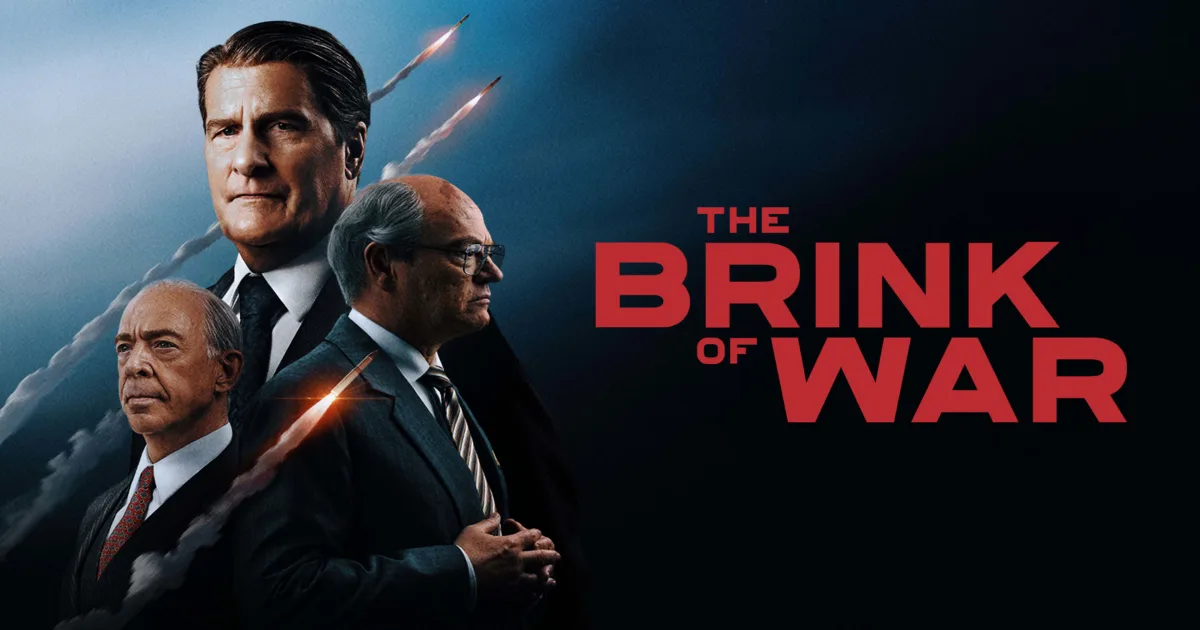
The Brink of War
SHOW TYPE

MOVIE
SHOW LENGTH

1 hr, 59 min
PROTECTION

TV-PG
RELEASED

2026



President Reagan races to save a nuclear deal with Soviet leader Mikhail Gorbachev as pressure mounts all around him. Every word spoken could move the world closer to peace - or destruction.
President Reagan races against time to salvage a deal with Soviet leader Mikhail Gorbachev that could dismantle nuclear arsenals - or ignite disaster.
With pressure mounting on all sides, every word spoken brings the world closer to peace or destruction.

Community verdict · separate from the catalog
No community verdict yet · In the review queue
2 of 5 members have weighed in. 100% have not labeled it woke. Search already lists this title; a community verdict lands at five.
2 of 2 did not label it woke · 5 members to decide
Community rank · quality, not a gate
Rank it — a rank is a vote that it is not woke. The catalog waits on a verdict and a written review.
Report a mistake
Same rule as woke labels: one report, a written reason, and the community +1 or −1 it — once per member. A net +5 applies the change. Editors can also apply it immediately.
No mistake reports yet.
Sign in to report a mistake. One report per field, per member.
Woke labels
Members can file a published criterion and itemized evidence. Other members +1 or −1 that reason — once. If 10% of members who weighed in file a label, and a reason reaches net +5, that rank keeps the title omitted from the database. Weak labels do not.
No labels filed yet.
A review is on the record even before the verdict. The title still needs 90% of members not labeling it woke before a review can put it in the catalog.
Comments and reviews
June Pell
+12 cloutSep 11, 2026
I went in expecting the usual heavy coat-and-tie parade, the kind of movie that makes you feel like you should be taking notes for a quiz later, and for the first twenty minutes it almost was that. Reagan alone with a stack of briefing books, the clock ticking somewhere offscreen, aides hovering like they might catch a cold if they get too close to a decision. Then the Reykjavik rooms start filling up and something shifts. The air gets thinner. I kept waiting for a big speech to break the tension and it never quite comes the way you think it will. There's this one stretch in the middle—maybe forty minutes in, I lost track—where the two of them are just sitting across a table that looks too small for the weight it's carrying. Reagan saying the thing about SDI again, Gorbachev pushing back without raising his voice, and the translators doing that half-second lag that somehow makes every line feel like it's traveling farther than it should. I rewound it. Twice. Not because I missed dialogue (the sound mix is clean enough) but because the faces do this quiet calculation that most summit movies skip. You can see Reagan deciding how much of his own certainty he's willing to spend, and Gorbachev weighing whether the man across from him is bluffing or just stubborn in a different language. (I may have rewound a third time for the way the light from the window catches the water glass. Or I was stalling. Hard to tell.) Anyway. The movie trusts that back-and-forth more than it trusts montage. No stock footage of missiles launching in slow motion to remind you the stakes are nuclear. You already know. What you get instead is the small friction of men who understand the theater of power and still have to sit there like regular people trying not to flinch. Supporting players orbit without turning into cartoons—hardliners on both sides who think any concession is surrender, staffers who look exhausted in a way that feels earned rather than staged for sympathy. One of Reagan's advisors has this habit of tapping a pen when the room goes quiet, and I found myself watching that pen more than the maps on the wall. Silly, maybe. But it kept me in the room. I kept waiting for the film to decide Reagan was either a saint or a cowboy who got lucky. It doesn't. He's vain about the right things, stubborn about the wrong ones, and occasionally funny in a dry way that lands because nobody underlines it. Gorbachev gets the same courtesy—ambitious, canny, carrying his own country on his back without the script turning him into a tragic reformer prop. Their final private exchange before everything nearly collapses is the scene I can't shake. No raised voices. Just the sense that both men have already spent the night mapping the worst outcome and are still choosing to talk. I sat forward on the couch like an idiot. (My dog walked through the frame of my living room and I actually shushed her.) Pacing gets a little thick in the third act when the pressure from Washington and Moscow starts stacking cables and side meetings. You can feel the runtime stretching while the principals wait for clearances that history already decided. A tighter cut might have helped, or maybe I'm just impatient when diplomacy starts looking like paperwork. Still, the movie never cheats by inventing a last-second miracle or a villain who needs booing. The brink is the point. You leave knowing how close the whole thing came to nothing, and how much of that closeness was two people deciding the other one was worth another hour. Production design does quiet work—the Icelandic exteriors look cold without being postcard pretty, the interior rooms feel lived-in by people who sleep badly. Score stays out of the way until it suddenly isn't, a low string thing under the walk to the cars at the end that made my throat do something unhelpful. I am not usually a crier at statesmen. Apparently tonight I was. It's not flashy. It won't give you a tidy moral or a standing ovation moment you can clip for later. What it does is put you in the room while the century holds its breath and lets two imperfect men try to talk the weapons down without looking weak. I kept thinking about that table afterward. How ordinary it looked. How much sat on it. Anyway. I watched the last ten minutes again before bed, just the leave-taking and the gray light outside. Still works.