
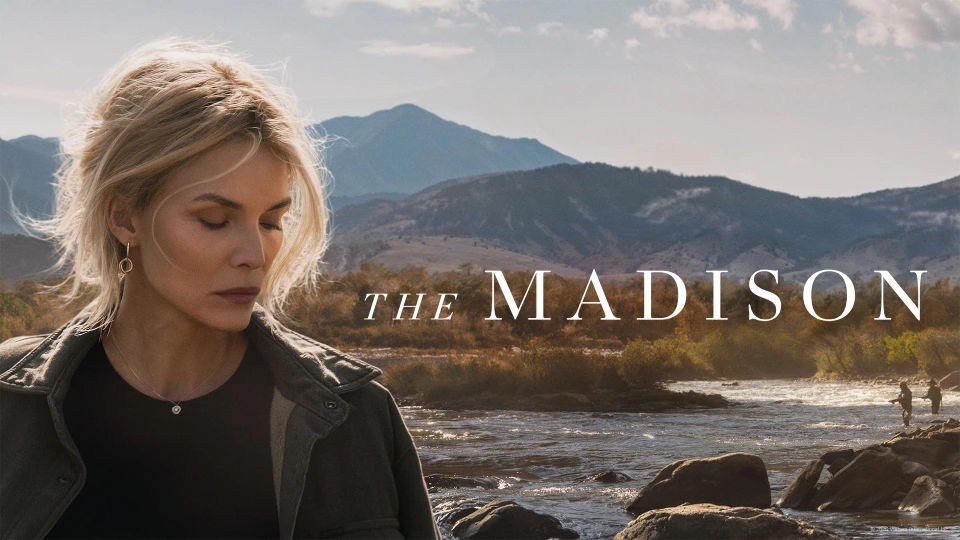
The Madison
SHOW TYPE

TV
SHOW LENGTH

1 hr
PROTECTION

TV-MA
RELEASED

2026



The Madison is a heartfelt study of grief and human connection following a New York City family in the Madison River valley of central Montana.
It is a profound love story channeled through a deeply personal family drama about resilience and transformation.
The Madison is unfolding across two distinct worlds - the beautiful landscape of Montana and the vibrant energy of Manhattan - as it examines the ties that bind families together.

Community verdict · separate from the catalog
No community verdict yet · In the review queue
1 of 5 members have weighed in. 100% have not labeled it woke. Search already lists this title; a community verdict lands at five.
1 of 1 did not label it woke · 5 members to decide
Community rank · quality, not a gate
Rank it — a rank is a vote that it is not woke. The catalog waits on a verdict and a written review.
Report a mistake
Same rule as woke labels: one report, a written reason, and the community +1 or −1 it — once per member. A net +5 applies the change. Editors can also apply it immediately.
No mistake reports yet.
Sign in to report a mistake. One report per field, per member.
Woke labels
Members can file a published criterion and itemized evidence. Other members +1 or −1 that reason — once. If 10% of members who weighed in file a label, and a reason reaches net +5, that rank keeps the title omitted from the database. Weak labels do not.
No labels filed yet.
A review is on the record even before the verdict. The title still needs 90% of members not labeling it woke before a review can put it in the catalog.
Comments and reviews
Omar Quill
+8 cloutSep 12, 2026
I sat down with The Madison over several evenings because the description mentioned Montana and a New York family, and I have always liked stories that move people between those two kinds of places. It is a television series from 2026, and it follows the Caldwells after they leave Manhattan and settle for a time in the Madison River valley in central Montana. The reason they go is grief. The mother, Claire, has lost her own mother quite suddenly, and the family is trying to hold together while the loss sits in every room with them. There is also a quieter thread about Claire and her husband Robert repairing something that had started to fray back in the city, though the show never makes that the loudest part of any episode. The series opens with the family still in their Upper West Side apartment. You see the children packing boxes, the older daughter arguing about leaving her school friends, the younger boy asking practical questions about fishing that no one can quite answer yet. Then the scene shifts to the long drive west, and later to the rented house near the river. The landscape is filmed with a lot of patience. Wide shots of the Madison, the grass moving, the light changing in the late afternoon. I found myself watching those more carefully than some of the dialogue scenes, because the dialogue can run long. People talk about what the grandmother meant to them, about whether Robert should keep consulting for his old firm remotely, about Claire's decision to pause her gallery work. It is all sincere. It is also the kind of talk that circles the same feelings more than once. There is a love story woven through the family material. It is not a new romance exactly. It is Claire and Robert remembering why they chose each other, and it is the older daughter beginning to notice a local boy who works summers on a nearby ranch. The show treats both with a gentle hand. You watch Claire and Robert take walks along the river at dusk and say things they had been too busy to say in New York. You watch the daughter learn how to handle a horse and realize she likes the quiet of it. Nothing moves very fast. Episodes often end on a quiet meal or a short conversation on a porch rather than a revelation. I appreciated that the writers did not feel the need to invent a villain or a sudden crisis every hour. The crisis is already there in the grief and in the simple difficulty of being a family in a new place. The Montana half of the show is stronger than the Manhattan half, in my view. When the story returns to the city for a funeral or a business meeting, the rooms feel tighter and the conversations more rehearsed. Back in the valley the characters loosen. Robert tries fly fishing and is not very good at it, which the show allows him to be. Claire starts a small project sorting through her mother's letters and photographs, and that becomes a way for her to talk with her children about the past without forcing a big speech. The boy finds a friend who knows the river and teaches him where the trout hold. These are small scenes, but they accumulate. By the middle of the season you feel the family has actually lived somewhere else for a while, not merely visited for the camera. I will admit I wanted a little more edge in places. Some of the healing arrives on schedule, and a few supporting characters from the local community exist mainly to offer wisdom or a spare tool. Still, the series never turns mean. It does not punish anyone for being from the city, and it does not romanticize ranch life into a sermon. People remain complicated. Robert is often tired and short. Claire can be distant even when she is trying. The daughter is impatient and then suddenly tender. That felt honest to me. The production is clean. The music stays out of the way most of the time. Performances are steady rather than showy. I never felt the actors were asking me to notice how hard they were working. The final episodes bring the family to a decision about whether to stay longer or return east, and the show earns that choice by having shown the slow work of living with loss rather than by inventing a last-minute disaster. I finished the season feeling I had spent time with people who were trying, which is more than some dramas manage. It is not perfect television, and it will not surprise anyone who has watched a family story before, but it is made with care and it respects the places it films. A quiet show about ordinary people learning to carry what they cannot put down.